Visionary, Inquisitor, and Self-Critique stages.
03 / Multimodal reasoning / 2026
AEGIS
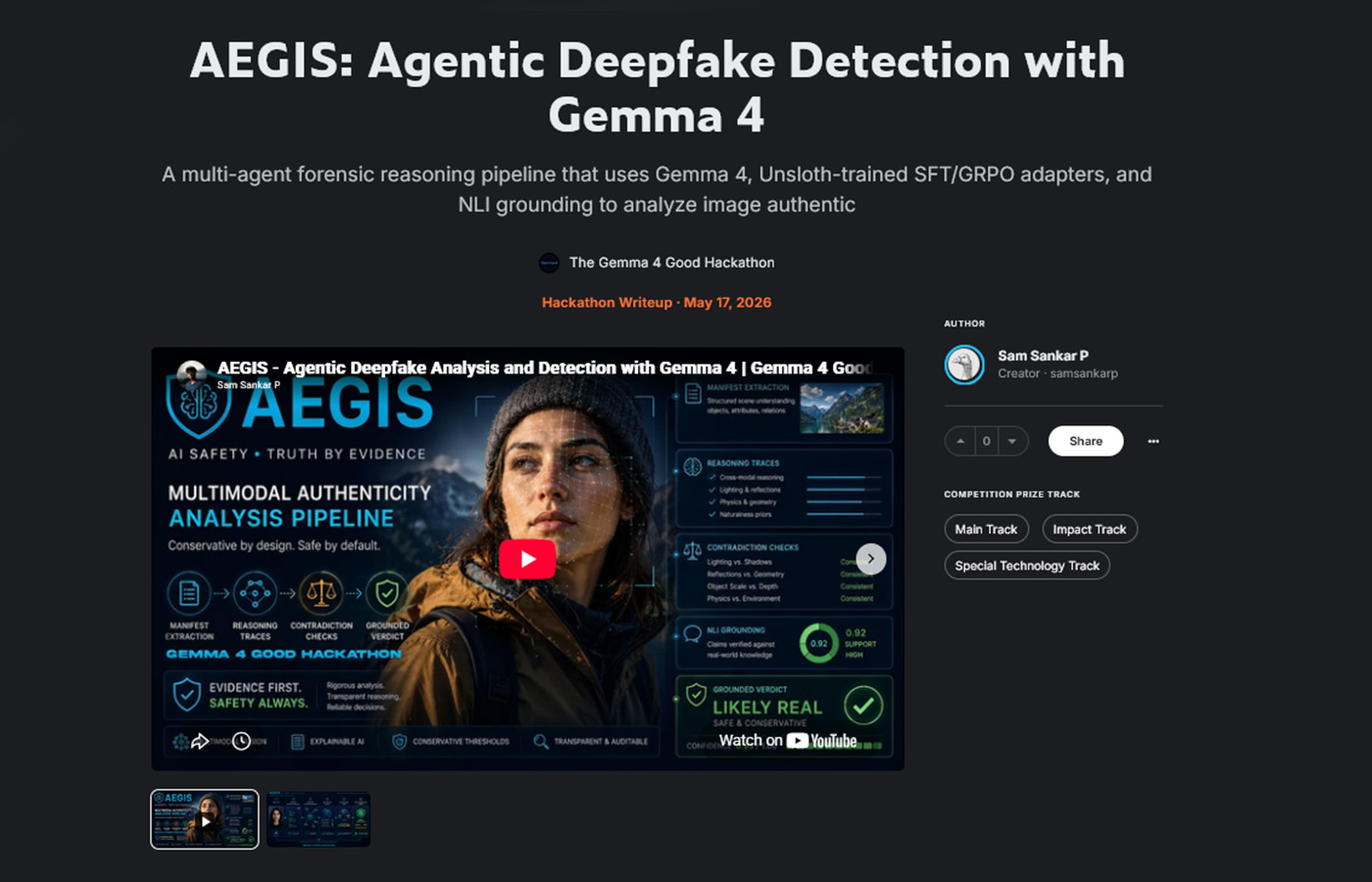
An interpretable deepfake-analysis pipeline using staged visual reasoning, self-critique, and contradiction-aware evidence aggregation.
- Role
- Pipeline design, fine-tuning, quantization, notebook delivery, and documentation
- Duration
- May 2026
- Status
- open-source
Two fine-tuning approaches released for inspection.
A quantized release intended for lighter local inference.
A contradiction-aware cross-encoder stage before the verdict.
A / EVIDENCE
Real outputs, releases, and source.
Product captures link to the live or published source. The architecture view is generated only from documented project layers and is not presented as a product screenshot.
 SOURCE ↗
EVIDENCE / 01
The published AEGIS Kaggle notebook, with the staged deepfake-analysis workflow available for inspection.
B / PROBLEM
What needed to change
A single opaque deepfake score offers little context for review. A useful analysis pipeline needs staged evidence, contradiction handling, and a conservative final decision.
C / SYSTEM RESPONSE
What I built
AEGIS uses three prompt-switched Gemma 4 E2B reasoning stages followed by a DeBERTa cross-encoder NLI judge and conservative aggregation.
D / ARCHITECTURE
The system, layer by layer.
Each layer below names its responsibility directly, preserving the distinction between repository evidence and explanatory architecture.
Visionary
Produces an initial evidence-oriented visual reading.
Inquisitor
Challenges the initial reading and seeks inconsistencies.
Self-Critique
Reviews the reasoning trail before judgment.
DeBERTa NLI judge
Filters contradictions before conservative aggregation.
E / ENGINEERING DECISIONS
Prompt-switched agents
Distinct roles structure inspection without requiring separate base models.
TRADE-OFFStages can inherit common model blind spots despite different prompts.
Contradiction filtering
An NLI stage makes conflicting claims visible before a verdict is formed.
TRADE-OFFThe judge introduces its own classification assumptions.
Local release path
SFT, GRPO, merged, and 4-bit GGUF artifacts support inspection across hardware profiles.
TRADE-OFFQuantization may change output behavior and requires separate validation.
F / STACK
Gemma 4 E2BPyTorchPEFTUnslothDeBERTa NLIGGUF
G / LIMITATIONS
Where the system stops.
- Deepfake analysis is probabilistic; outputs are not forensic proof and require human review.
- The pipeline can inherit dataset and model biases from its training and evaluation sources.
- This portfolio visualizes the documented pipeline and does not run inference in the browser.
H / WHAT I LEARNED
What the build clarified.
- Interpretability improves when intermediate disagreement is retained rather than hidden.
- Conservative aggregation is a system behavior, not a substitute for evidence quality.